Gwendolyn J. Lindsay Cooley
Two decades inside the work.
The antitrust expertise behind Taimet is not consulted - it's foundational. Gwendolyn Lindsay Cooley spent nineteen years as Wisconsin's Assistant Attorney General for Antitrust, doing this work, in every industry, working with every level of government.
That enforcement career - hundreds of cases, coalitions of forty-two states, landmark pharmaceutical settlements, Senate testimony - is the analytical engine Taimet runs on.
Built from the inside out.
Most people understand antitrust as law. Gwendolyn Lindsay Cooley understands it as practice - as the daily work of determining which mergers harm competition, which markets matter, and how enforcement decisions actually get made in agencies, coalitions, and courtrooms.
From 2005 to 2024, she served as Wisconsin's Assistant Attorney General for Antitrust, working across four Attorneys General - two Republican, two Democrat - on cases spanning pharmaceuticals, technology, agriculture, telecommunications, and healthcare. She investigated hundreds of cases.
“Antitrust is wonderfully hard,” she has said. “I fell in love with it in 2005 and I've never looked back.”
Having spent twenty years analyzing mergers from inside the regulatory process, she saw exactly where the bottlenecks were - and exactly what a rigorous, expert-tuned AI tool could do to fix them. That recognition is what led her to found Taimet.
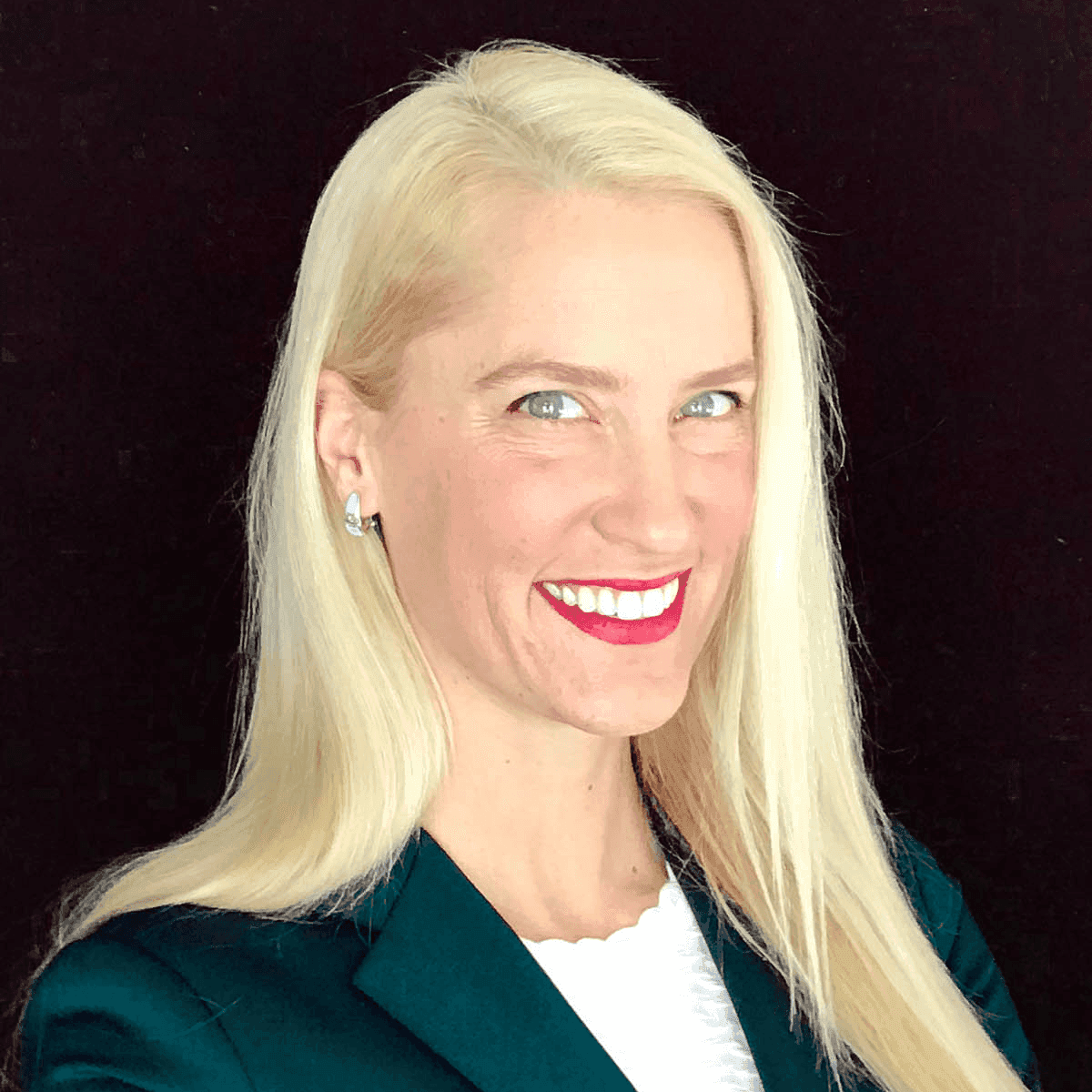
A career in enforcement.
High-stakes enforcement, across every industry.
From pharmaceuticals to telecommunications to Big Tech, she has worked the cases that defined state antitrust enforcement for a generation. That breadth is what makes the difference between analysis that sounds expert and analysis that actually is.
Wisconsin v. Indivior
Suboxone Antitrust Litigation · E.D. Pa.
One of the career-defining cases of her enforcement career. Starting in 2016, Gwendolyn led attorneys general from 42 states in a federal lawsuit alleging that the manufacturers of Suboxone - a critical opioid treatment drug - illegally blocked generic competitors from reaching patients.
For eight years, she maintained consensus across a coalition that spanned every political stripe. She argued motions to dismiss, shepherded the case through summary judgment, and kept all 42 states engaged and aligned through the run-up to trial - where the defendants ultimately settled for $102.5 million.
“My colleagues still say that was the most well-executed multistate antitrust case they'd ever seen.”
The case mattered because access to affordable opioid treatment drugs is a public-health imperative. That combination - legal rigor, coalition management, and public-interest mission - is the foundation of how Gwendolyn approaches every problem she works on.
T-Mobile / Sprint
States' challenge · 2019
Co-led the trial team for the states' challenge to the T-Mobile/Sprint merger, and later served as lead negotiator for the states on the post-verdict $15 million settlement. One of the highest-profile telecom antitrust battles in recent history, the case gave her direct insight into how regulators evaluate horizontal consolidation at scale.
Big Tech
Google · Apple · Amazon · Facebook
Lead attorney for Wisconsin on cases against Apple and Amazon, with additional counsel roles against Google and Facebook. A DC District Court found Google a monopolist in 2024 in the Search case. Bipartisan coalitions of states, coordinated with the FTC and DOJ.
Pharmaceutical Enforcement
Paxil · Suboxone · FTC's Future of Pharma initiative
Her first case was Paxil. She later co-chaired the NAAG Pharmaceutical Industry Working Group, led the Reimagining Pharma AGs Advisory Group, and served as a delegate to the FTC's Future of Pharma Mergers international initiative. Pharmaceutical market definition - one of the most technically demanding areas in antitrust - is expertise she carries into every Taimet analysis.
Google Play Store
Utah v. Google · N.D. Cal. · 2024
Lead attorney for Wisconsin in Utah v. Google, challenging anticompetitive practices in the Google Play Store. The case resulted in a proposed $700 million settlement, pending court approval.
eBooks / Apple Price-Fixing
Texas et al. v. Penguin Group · S.D.N.Y. · 2012
Head of the expert committee in the landmark eBooks price-fixing case. The states prevailed against Apple on appeal (U.S. v. Apple, 791 F.3d 290, 2015), resulting in a $450 million nationwide settlement.
Flat Panel Screen Conspiracy
Missouri v. AU Optronics · MDL 1827 · N.D. Cal.
Part of the multistate enforcement effort against the flat panel screen price-fixing conspiracy. The investigation and litigation resulted in $1.1 billion in combined settlements, one of the largest antitrust recoveries of its kind.
Chair, 2021-2024.
Fifty-six attorneys general.
Both parties. One voice.
Antitrust is one of the few areas of public law where genuine bipartisan consensus holds. Not because it avoids controversy - it doesn't - but because market harm and consumer harm are not partisan questions. Competition either works or it doesn't. That's why Attorneys General from Nebraska and New York, Tennessee and California, routinely find themselves on the same side of a case.
From 2021 to 2024, Gwendolyn chaired the National Association of Attorneys General Multistate Antitrust Task Force - 270 nonpartisan civil servants coordinating enforcement coalitions across state, federal, and international agencies. She was selected for the role by both a Republican AG and a Democratic AG. The practical work of that chairship was getting Florida and California, New York and Missouri, Utah and Vermont to reach not just agreement, but unanimous agreement on existential matters - and keeping fifty-six attorneys general walking into a courtroom as one.
“How? How are you possibly getting Florida and California and New York and Pennsylvania and Arizona and Utah and Tennessee and Vermont and everyone else to agree with Wisconsin?”
During her chairship, she traveled 100+ days a year advocating for states at think tanks, law firms, law schools, and conferences spanning the full ideological range - from the Federalist Society to progressive policy forums, from conservative legal conferences to liberal advocacy groups. She created training programs (including the Antitrust 101 series), instituted a mentorship program, revised the enforcement manual, and built new committees to keep the Task Force ahead of legislative and regulatory change.
She served four Attorneys General - two Republicans, two Democrats. She won and lost before federal judges appointed by presidents of both parties. State legislatures from Tennessee to Indiana to Washington State passed bipartisan antitrust enhancement laws during her chairship. Her view on that whole record: “Justice, not victory.” Enforcement that loses cases is evidence the system is fair. That's not an apology - it's the point.
At the table with the world's top enforcers.
During her chairship, Gwendolyn was a recurring presence at the ABA Antitrust Spring Meeting's Enforcers' Roundtable - the field's most prominent annual gathering - joining the FTC Chair, DOJ Antitrust Chief, EU Competition Commissioner, UK CMA CEO, and enforcement leaders from across the globe.
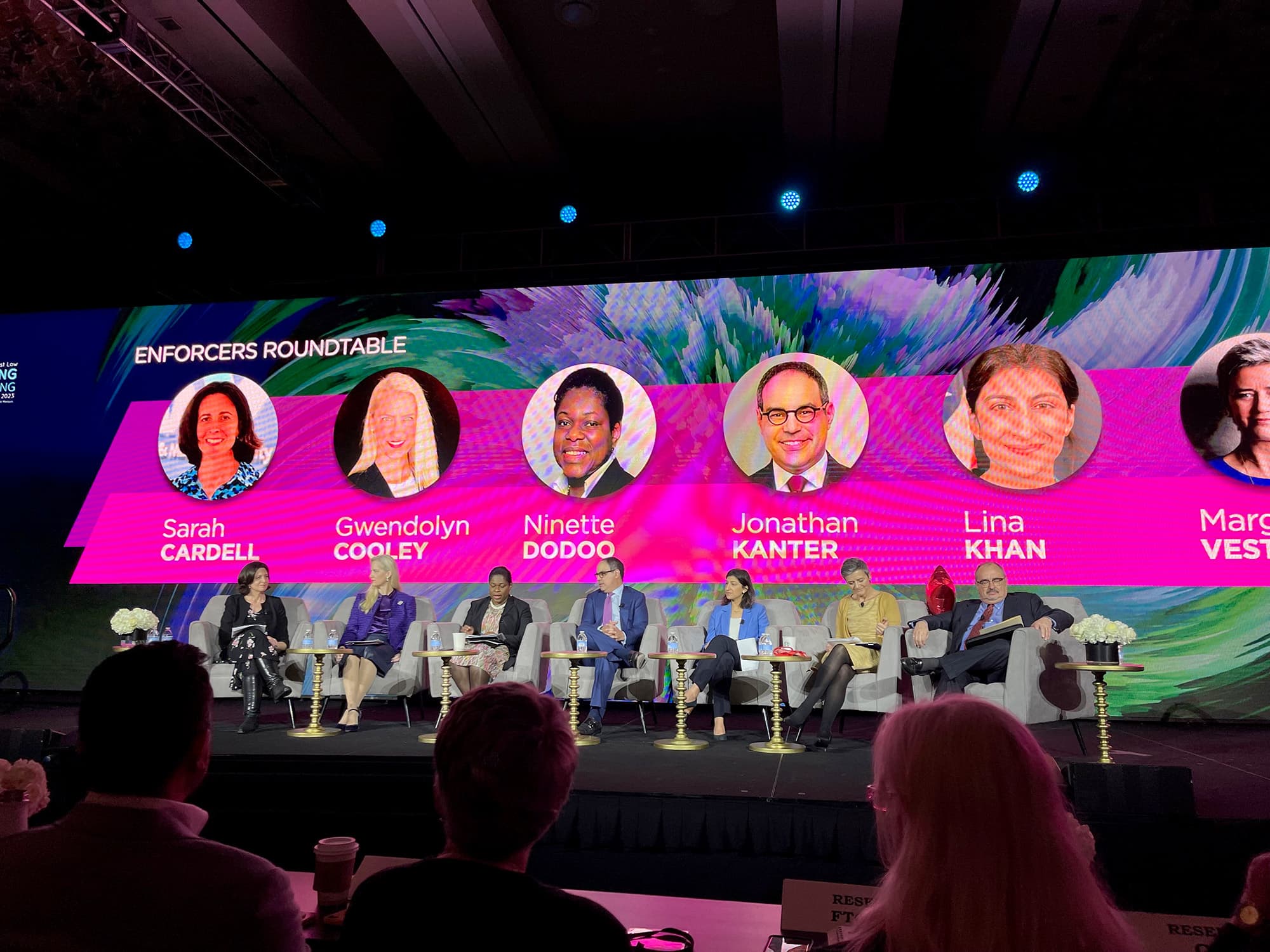
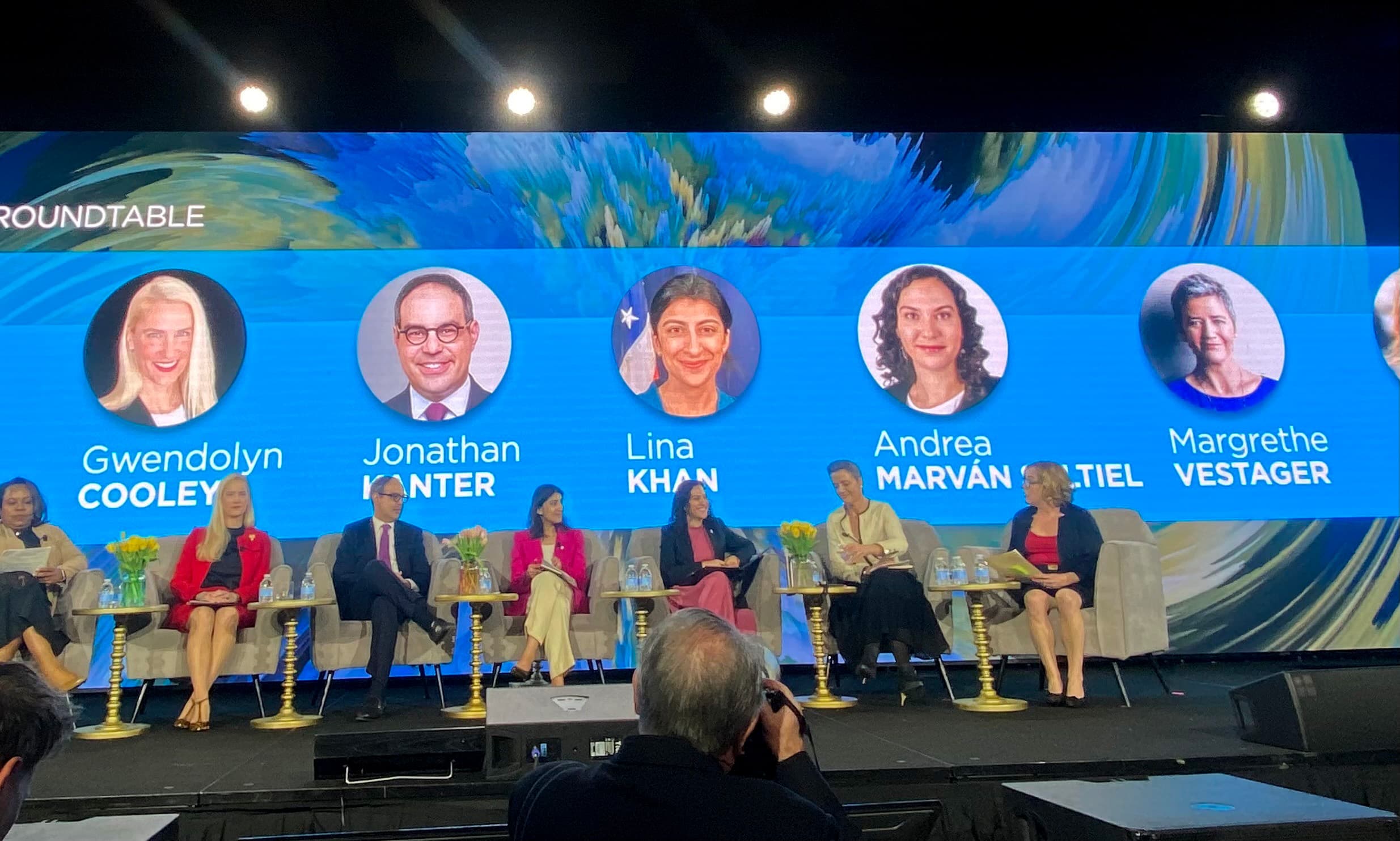
ABA Antitrust Spring Meeting · Enforcers' Roundtable · Washington, D.C., 2023
ABA Antitrust Spring Meeting · Enforcers' Roundtable · Washington, D.C., 2024
Testimony before Congress.
Invited to testify before the U.S. Senate Subcommittee on Competition Policy, Antitrust and Consumer Rights in December 2024, Gwendolyn spoke to the century-long history of state AG antitrust enforcement and the bipartisan case for continuing it.
Her testimony covered the cooperative enforcement record of state AGs working across party lines - from Standard Oil in the 1900s to Big Tech today; the landmark Suboxone case and the organizational discipline required to sustain unanimous multistate consensus across eight years; the federal-state partnership model and how SAEVA (the State Antitrust Enforcement Venue Act) strengthened it; and the need for technology to help enforcement agencies deal with workload efficiently.
“It is my hope - and is the focus of my company's business - that the agencies will embrace technology to help with efficiency in this process.”
On merger enforcement, she testified that challenge rates have been remarkably consistent across administrations - not because of ideology, but because of workload. Agencies are doing the best they can with finite staff reviewing a variable volume of filings, some concerning and some easily cleared. Her point: technology that improves triage efficiency is not a luxury - it is a necessity.
That argument, made to the U.S. Senate, is the same argument Taimet makes to its customers: consistent, expert-quality initial screening should not be limited by how many people have time to do it.
The reasoning encoded into the system isn't theoretical. It's hers.
Most AI products are built by researchers who consult lawyers. Taimet inverts that. Gwendolyn founded and leads the company, and her enforcement reasoning is not a layer added at the end - it is the foundation from which every analytical step in the system was designed.
The build process was deliberate: Taimet's co-founder, who leads product and technology, pressed her on every step of how she would actually analyze a merger - every detail, every edge case, every industry-specific nuance she would know to check, and the deep research to support the methodology. Once they both deeply understood a step, they crafted the prompts together - often pages long - to encode her reasoning. Then they iterated, often building sub-systems for the parts that needed greater precision or speed.
The result is a system that reasons the way a trained enforcer does. Not because it was trained on her data - but because her thinking shaped every decision about how the system approaches a problem.
She is also a recognized voice on the intersection of AI and antitrust enforcement. In January 2026, she presented on AI applications for antitrust prescreening at the National Association for Business Economics (NABE), reinforcing the vision that drives Taimet.
The enforcer vignettes below are three examples of working knowledge - the kind held only by people who have spent years doing this - that is encoded into Taimet and unavailable in any general-purpose AI.
Pharmaceutical market definition
Small-molecule drugs are in the same market only if they share an identical molecular structure and are AB-rated for each other. Biologics are in the same market only if they’re biosimilars and treat the same disease. The distinction determines whether a pharma deal looks like a horizontal overlap or a non-issue. Most analysts don’t know it. Taimet does - and applies it automatically.
State enforcement patterns
Different state attorneys general challenge different kinds of mergers. Some are aggressive on hospital consolidation. Others on agriculture. Others on tech. Taimet knows which jurisdictions are likely to act on which transactions, which state-level enforcement theories apply, and which mergers will draw multistate coalitions.
Where the evidence actually lives
Pricing-power evidence often surfaces in investor presentations. Foreclosure intent shows up in board materials. Public statements about competitive intent surface in regulatory filings before they show up in press releases. Taimet knows where to look - because the person who designed it spent two decades looking there.
A voice the field listens to.
Antitrust 101 Podcast
Biweekly episodes covering landmark antitrust cases for practitioners and law students. Available on Spotify and Apple Podcasts.
Listen on Spotify or Apple PodcastsSenate Testimony
Written testimony before the U.S. Senate Subcommittee on Competition Policy, Antitrust and Consumer Rights. December 2024.
Read the full testimonyGeorgetown Law Journal Online
"Prior Bad Acts and Merger Review," with Michael A. Carrier, 111 Geo. L.J. Online 106 (2023). Nominated for a 2024 Antitrust Writing Award (Concurrences).
Read the article (PDF)ABA Antitrust Magazine
"Getting Better at Algorithmic Pricing," November 2025. Addresses one of the most active frontiers in antitrust enforcement.
Read the articleJournal of Antitrust Enforcement
"Having their say: everyone weighs in on Illumina GRAIL," Oxford University Press, October 2023.
Read on Oxford AcademicGeorge Mason Law Review
"Five Big Cases: Insights On the Last 25 Years of Antitrust Enforcement," Vol. 29, No. 4, Summer 2022.
2023 Merger Guideline Comments
Part of the team that drafted the states' comments on the proposed merger guidelines the FTC adopted in 2023 - the same guidelines Taimet applies to every analysis.
ABA Antitrust Section Leadership
Conference Chair for the ABA Antitrust Section Fall Forum (2025) and the Global Private Litigation Conference in London (2025). Previously Co-Chair of the State Enforcement Committee (2016-2022). Active Council member, with more than 100 conference presentations spanning two decades.
"State Enforcer You Need to Know" (ABA)Awards & Recognition
2023 NAAG Attorney General Career Staff Award (nationwide recognition). Named "Woman Making History" by Wisconsin Lawyer magazine in 2024. ABA Antitrust Section Committee Innovation Award (2021). Featured in Bloomberg, Reuters, and Wisconsin Public Radio.
See the expertise in action
Twenty years of enforcement reasoning - in your next analysis.